
After learning kana (Hiragana and Katakana), you will have the opportunity to start picking up vocabulary through the native writing system. This will be exceptionally handy because, although you can always expect to have kana with vocabulary resources, you can NOT always expect to have romaji (Japanese that is written in latin script). You will want to start picking up kanji alongside vocabulary as well, but we will discuss that in the next section. This section is about understanding the initial goals and initial habits for vocabulary learning that will advance you through to the next stages of language learning.
The first and most important thing to know for beginning language learners is this: the most common 1000 words of any language constitute roughly 85% of everyday speech and text. This is a strange and lesser known fact about the limits of human communication, and it follows a trend called “Zipf’s Law”, where the frequency of something is inversely proportional to it’s ordered rank in frequency. That is, for example, the 1000th most common word in any language appears about 1/1000th as frequently as the most common word. The numbers vary slightly from language to language or text to text, but the trend is the same:
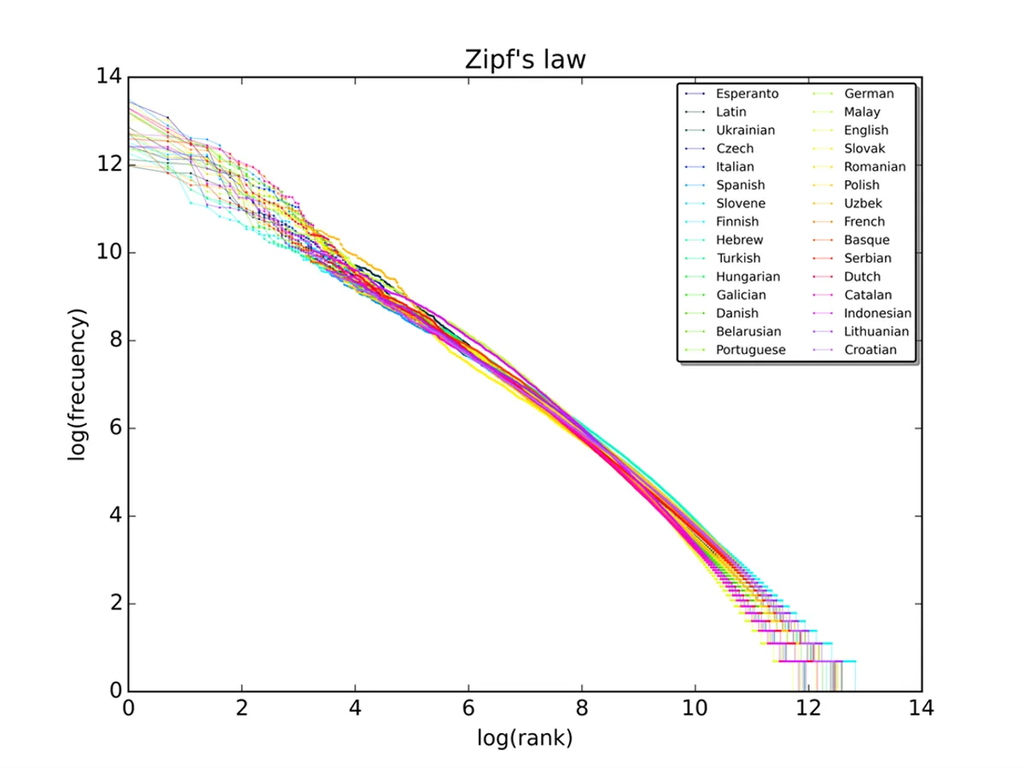
If you take this into consideration, now the goal of getting to the level of basic understanding in a language becomes a lot simpler and a lot closer: if you can learn roughly 1000 words, then you can start reading and listening. Depending on your strategy and your general learning and memorization ability (which can improve with time, mind you!), this will usually take between 2 to 6 months. Knowing 1000 words doesn’t necessarily mean knowing them all perfectly, but you should be able to recognize them most of the time.
Thankfully, I have a strategy for this vocabulary step, and it helps solve one of the main struggles with self-teaching a language: burnout. The strategy is quite the same as for learning kana, and that is to use an Anki deck for Japanese sorted by word frequency while taking in just a small number of words each day. It is best for Anki beginners to only introduce between 5 and 15 words per day. This is because language learning is a marathon, and not a sprint, so building a small, manageable, daily habit is much more important than trying to test your limits.
If you can manage introducing 10 new words per day in Anki, then you will reach your 1000th word between 3 and 4 months, at which point you can actually start to read in order to build up a natural sense for grammar. In order to read, you will also want to have been practicing kanji, so check out the kanji page for reference on that front.
The last thing to note about vocabulary is that oftentimes it is not a 1-to-1 comparison between a word in English and a word in Japanese. This makes a good Japanese dictionary extremely useful, and when things don’t seem to line up, searching a list of meanings and sample sentences can help you to understand when things are similar but not identical. My favorite Japanese dictionary is Jisho.org. In the future, when you are practicing reading, writing, listening, and speaking, you will find dictionaries to be indispensable.