Learning kana is the essential first step for most learners of Japanese, because once you can read these characters you will have access to the tools that will be necessary for the entire learning process. It’s also one of the most enjoyable part of studying Japanese, as the characters are really expressive and fun to read and write. Furthermore, it’s simple enough to acquire them with only 92 characters in total — 46 for hiragana and 46 for katakana, which represent the same set of sounds.
Kana is called a “syllabary”, which means that each character represents a whole syllable as opposed to individual sounds like in an alphabet. There are 5 vowels — [ah, ee, oo, ay, oh] — represented by [a, i, u, e, o] and there are 14 initial consonants represented by [k, g, s, z, t, d, n, h, b, p, m, y, r, w]. Not all of the combinations are used, but most of them are, and there is one more character [ん] which represents an [n] at the end of syllables. Below is an illustration of all the base hiragana characters you will have to learn:
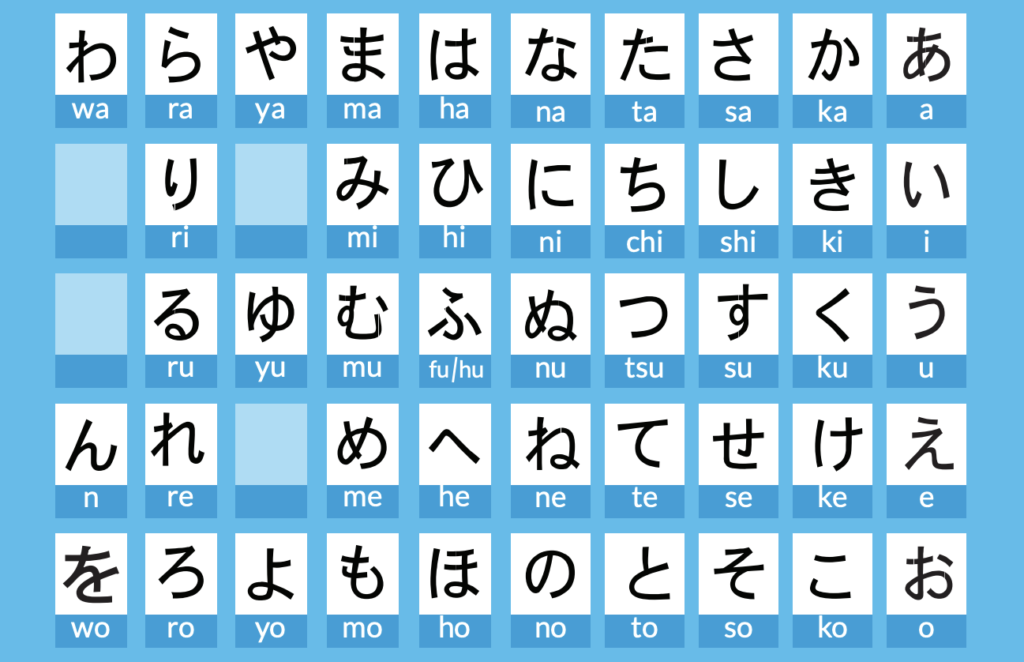
Note: the characters with [g, z, d, b, p] as initial consonants just have some marks added to these base characters. For example: [が, ざ, だ, ば, ぱ]. You will learn these later.
As for actually stepping into the memorization process and learning your kana nibble by nibble, there is an excellent method using a system called “Anki”. Anki, as I have found, is practically the bread and butter for making self-taught progress in vocabulary and plenty of other things related to memorization. Anki is just a flash-card tool that is free for computers and free on android; but because Apple charges developers to include apps in their store, they do charge for it specifically on the iPhone. Users make their own flash-card decks and share them publicly, so pretty much anything you want to learn is already made into a deck and freely available.
The best thing about Anki, aside from being free and open-source, is that it uses “spaced repetition” to help you memorize. Spaced repetition is a method of bringing the object of memorization back just when you are nearing the point of forgetting it. This means that A) you are not wasting time on information that you just learned/reviewed and B) you are hitting the point where memory reacts BEST to review. Take a look at this graph as an example of what happens when you use spaced repetition:
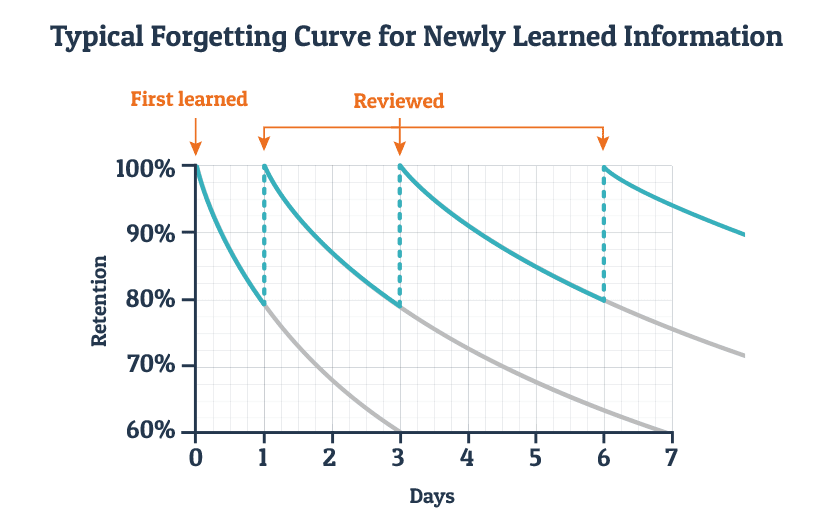
With spaced repetition, you can be so much more efficient than otherwise. That being said, for kana, open up Anki and include this kana deck into your list of decks. Go into the setting and set the new card introduction rate to something low, like 5 per day or less, and start there. You can increase the number later, but you’ll be better off starting slow and taking your time, especially as you’re getting used to it. The most important thing here, and I really do mean this, is that you want to be able to get into the habit of doing a little bit of Anki every day. If you can build that habit over a month or so, the whole process of learning Japanese really comes within reach.
As you’re learning this deck, have a pen and paper with you, and work on writing out the hiragana and katakana by hand. You could focus just on hiragana at first too, if you like, as katakana is mainly used in special circumstances like foreign words and stylistic things. Also, feel free to just take a look at a cheat sheet and practice recalling them; the more practice the better. Just don’t overdo it or you are very likely to burn out. Language burnout is practically the #1 reason why independent learners stop in their progress, so take it easy and learn how to pace yourself. Language learning is a marathon, not a race, and you will see that if you get into the habit of taking just some little steps each day, you will often have retrospective moments that just make your progress so obvious.